User Interview, Co-Design, Affinity Mapping
Exploring Resilience in Adaptation
Gathering insights from international students’ experiences and identifying opportunity areas
Gathering insights from international students’ experiences and identifying opportunity areas
School Project, 2024
Researcher
Facilitator in Co-design
User Interview
Affinity Mapping
Synthesizing Data
Group of 5 classmates in Strategic Foresight and Innovation program
Through user interviews and co-design exercises, we gather insights into how international students navigate obtaining permanent resident status and adapting to daily life in a new country.
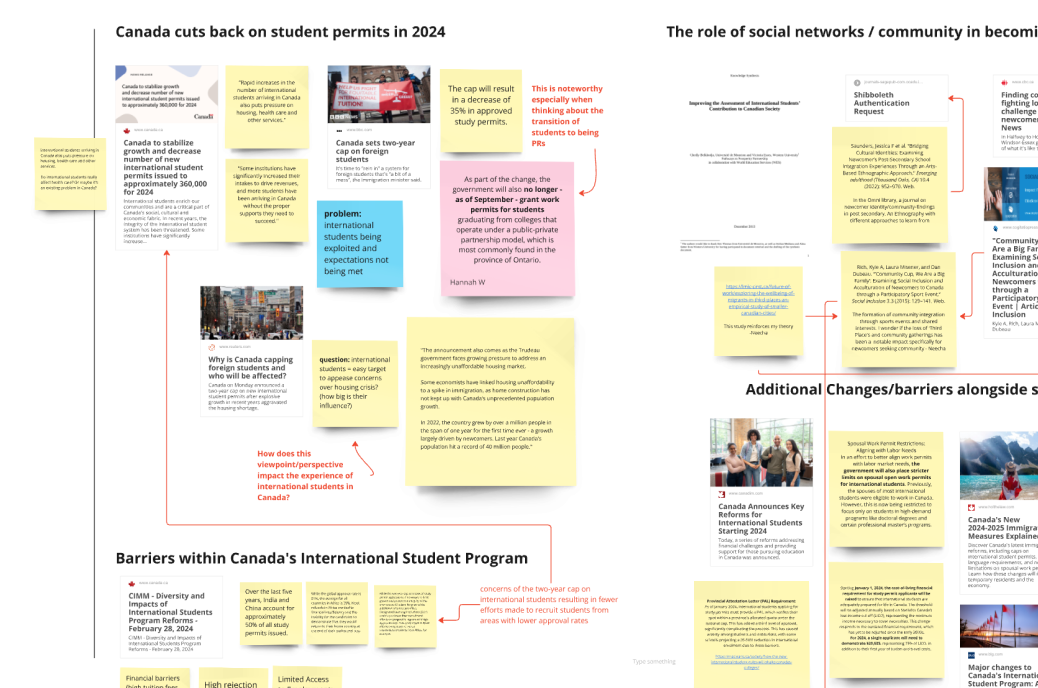
The Canadian government has published a series of new policies, such as capping international study permits and introducing new language proficiency requirements, to ensure the sustainability of its immigration system (Igor Kyryliuk, 2024). As a team comprising both international and domestic students, we are curious to understand how international students are coping with these policy changes and how their lives are being affected emotionally.
I conducted 2 out of 7 interviews and synthesized the data using affinity mapping with the team. Additionally, I worked as a facilitator to host the co-design session.
Desire-Based Interviews and Relationality
Instead of conducting needs-based interviews that focus on current problems and issues, we adopt desire-based interviews, asking participants what they envision for a better space.
We also emphasize the relationality between researchers and participants during interviews. Rather than positioning ourselves as experts, we create space for participants to share their stories with us.
Since our goal is to understand participants’ physical and psychological journeys living in Canada, this approach ensures participants feel comfortable and fosters trust with researchers, encouraging them to share their experiences.
Co-Design
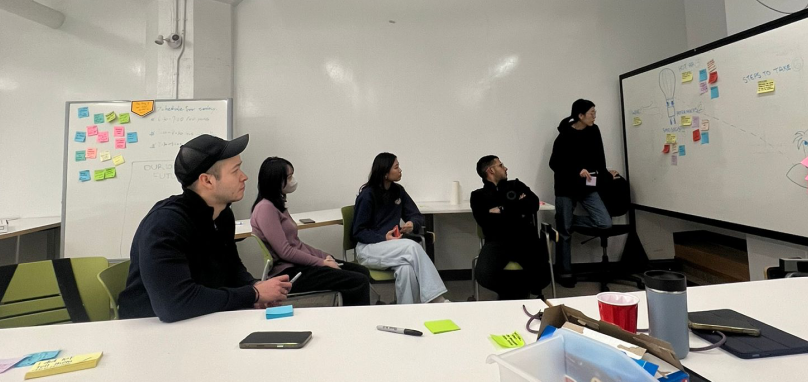
By turning designers into facilitators, we decenter the role of the designer. In this session, we invited four participants to map their journeys as international students.
While sharing their experiences and thoughts, they also took the lead, allowing researchers to understand what is happening in their lives and how external forces affect their decision-making and emotions.
We brainstorm as a group and consult with the instructors to finalize our research questions, ensuring they align with the goal of creating space for participants and building trust with researchers.
Goal
Interview Questions
Goal
Interview Questions
Goal
Interview Questions
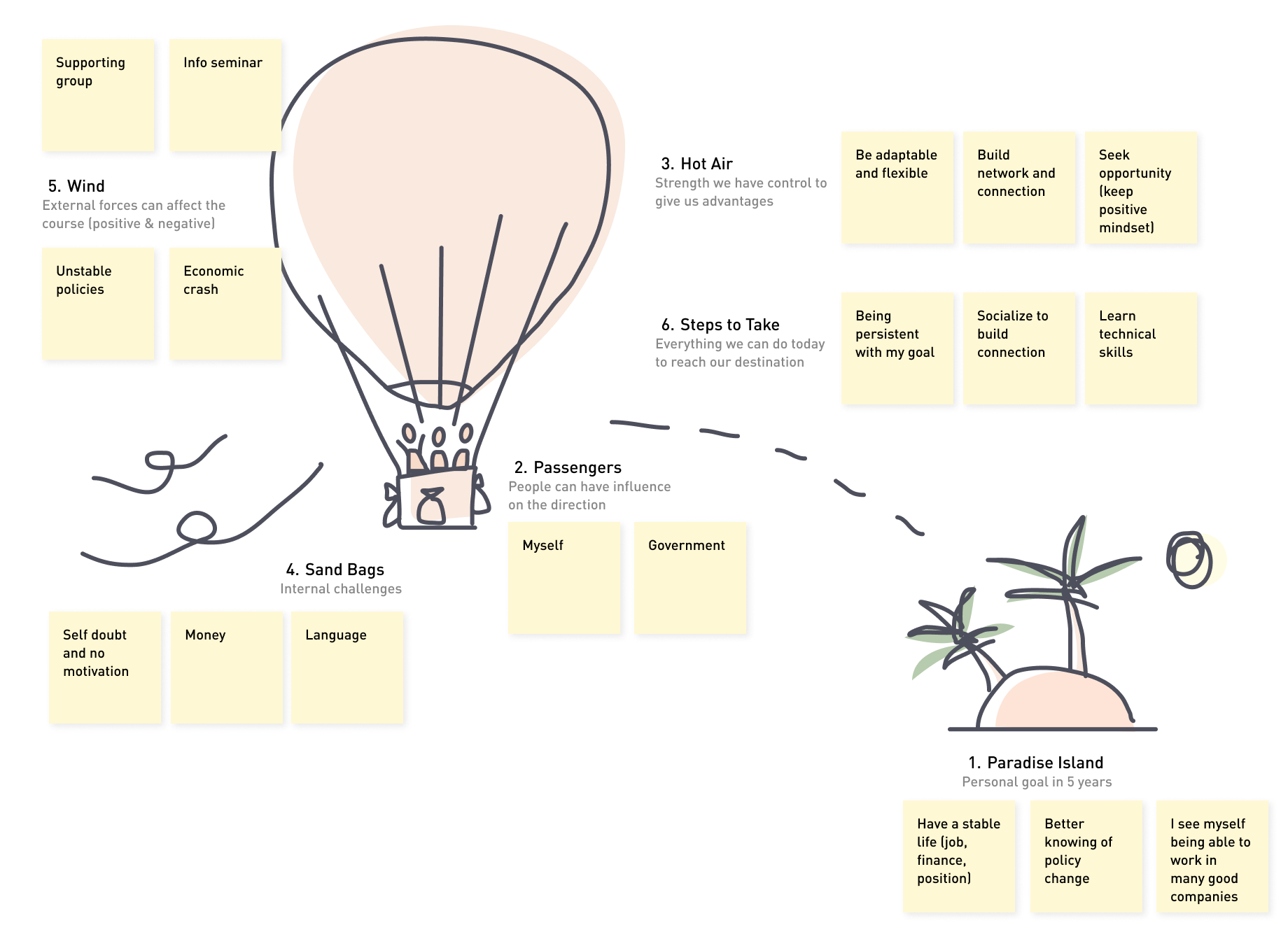
We conduct a Hot Air Balloon exercise with four participants to explore their ideal life and how they can achieve it through Co-Design. This exercise allows us to validate our interview insights and ensure that potential coping strategies align with the experiences of most international students.
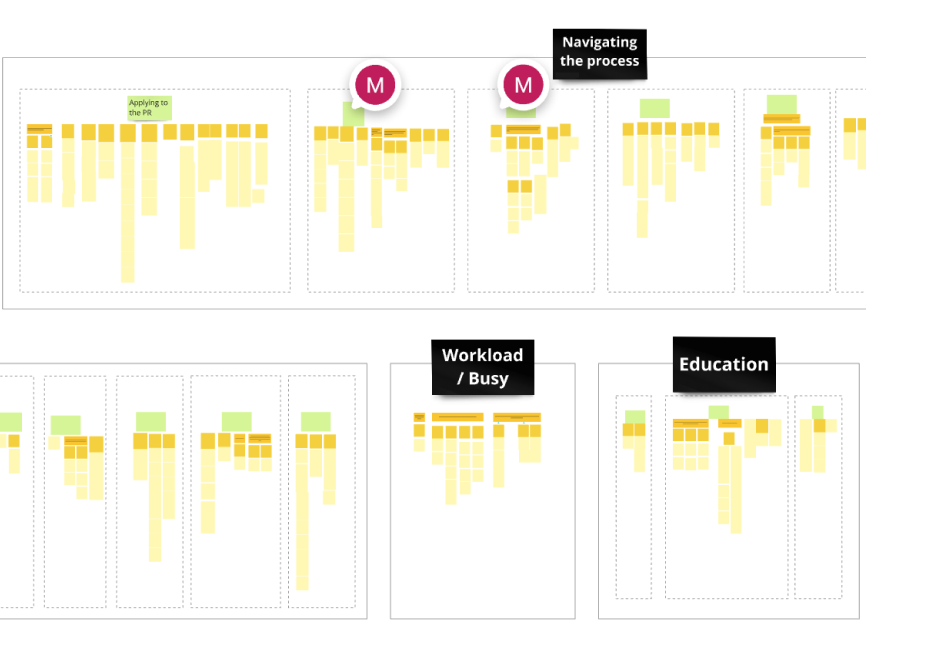
We work together to analyze the interview scripts and categorize them based on similar themes, such as applying for permanent residency and connecting with community groups.
Then, we combine related themes into larger categories, such as navigating systems and building connections to familiarity and support.
Inspired by quotes from participants, we found that constant policy changes make international students feel like players in a game, yet they have no control over the system. We integrated these key insights into a game-playing theme to present our findings.
" I feel like they are playing games.
They offered me something and then they changed it, and changed it, and changed it, and changed it."
- Participant A
" Getting PR was a huge milestone. It provides a sense of stability
and the opportunity to finally call Canada my home."
- Participant B
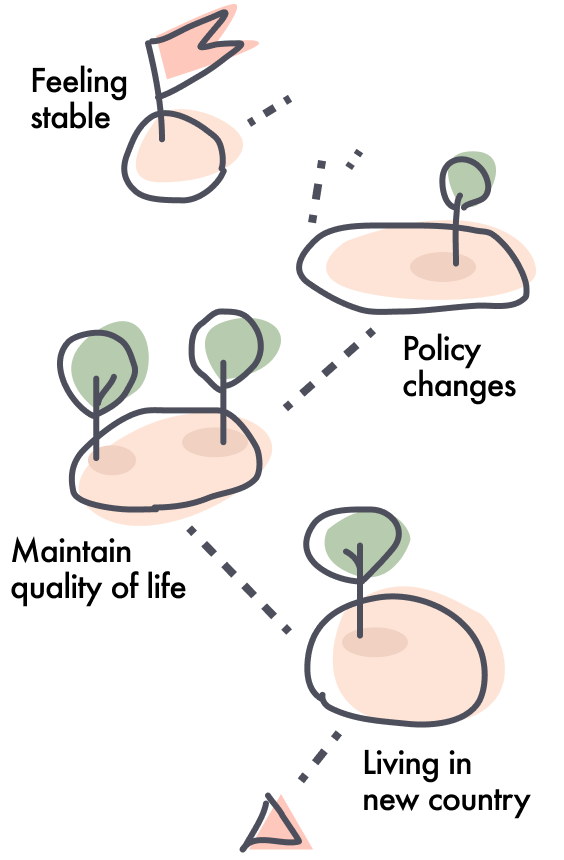
To pursue a better quality of life, many international students leave their lives back home and move to Canada, motivated by the desire for a safer place.
"One of the things that drew me to Canada was the sense of safety and stability.
I knew that it was a country where immigrants could build a future with fewer barriers compared to other places."

Some International students are self-conscious about their English proficiency, which leads to frustration in their academic performance and social interactions.
"I did in a softball team.
I didn't really integrate because I didn't trust in my English skills.
So, I didn't kind of integrate myself into the group. Not because of them,
but because of me. "
The unclear rules and requirements of the current immigration system frustrate international students as they navigate the process.
"If I could change one thing,
I would make the process a bit more transparent, especially around timelines.
There were times when I felt lost, waiting for responses without a clear idea of what to expect next. Clearer guidelines and support at every stage would make a big difference for newcomers."

While international students feel pressure and disrupted plans caused by sudden policy changes, they long for a more stable life in five years as a response to their current experiences.
Facing Uncertainty
Longing for Stability
"Some moments were frustrating,
especially dealing with last-minute changes in policy.
After years of saving and planning, it felt unfair to face these sudden uncertainties."

Having a support network of other students who have lived through the process is essential for creating new strategies and coping with political changes.
"Having a support network has been one of the biggest helps in navigating life here.
Whether it’s other students, family, or community groups, these connections make a huge difference. Being able to ask for advice or just share experiences has kept me grounded."
Community as a bridge to belonging
Support networks, such as cultural and faith-based communities, play a pivotal role in helping international students adapt and thrive in new environments.
The power of shared experience
Connecting with others who share a similar journey fosters resilience and emotional support. Challenges must not be dealt with individually - community helps to cope.
Resources for international students at school
Universities often hold workshops and info sessions with advice on how to navigate the process of getting a PGWP and PR. It’s helpful for students to use theses early on.
"Being around people who understand the immigrant journey has helped me cope with the challenges.
Whether it’s other students, family, or community groups, these connections make a huge difference. Being able to ask for advice or just share experiences has kept me grounded."
The co-design sessions themselves were transformative for our team and participants. We learned how impactful an open conversation about the challenges International students face can be - both as a safe place to vent for newcomers, and for Canadians to better understand.
“It was great to learn about other students' experiences and corroborate that we all have similar perspectives.”